
Buy link: https://chiselbury.co.uk/shop/
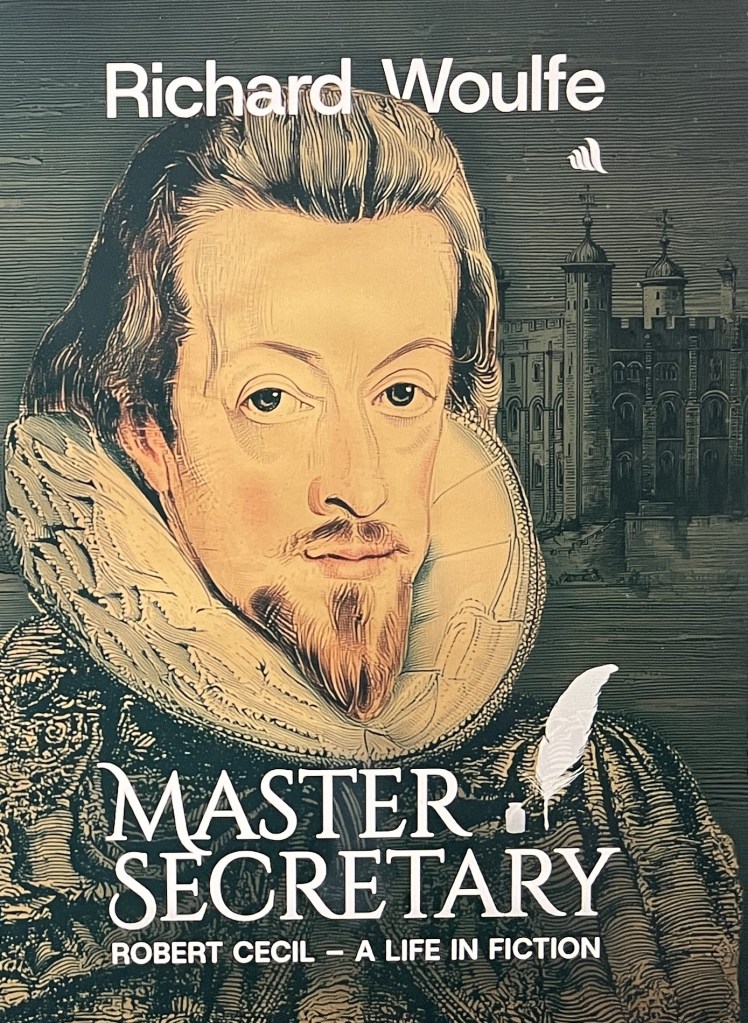
Richard Woulfe has just published Master Secretary: Robert Cecil, A Life in Fiction, a new collection of stories centred on one of England’s most intriguing historical figures. It’s an exciting release, and I’m delighted to share the news with you.
“Statesman, strategist, survivor: Robert Cecil stood at the very heart of England’s transition from Tudor to Stuart rule. Hunched-backed and underestimated in an age hostile to disability, he rose to become Master Secretary to Elizabeth I and James I, suppressing the Essex Rebellion, foiling the Gunpowder Plot, and negotiating peace with Spain.
In this richly imagined sequence of eighteen interlinked stories, Cecil’s voice is joined by those of his family, allies, and adversaries—Elizabeth I, Anthony and Francis Bacon, Walter Raleigh, Ben Jonson, Arbella Stuart, and nameless spies and commoners whose lives brushed against his. From court intrigue to tavern gossip, from the grandeur of the Somerset House Peace Conference to a humble Limerick shop, these tales weave fact and fiction into a vivid portrait of one of history’s most remarkable political survivors.
Spanning his birth to his final conversation with the sculptor designing his tomb, Master Secretary opens a window onto the world Shakespeare inhabited—a world of politics and diplomacy, comedy and tragedy, faith and betrayal. Grounded in historical record yet alive with imagination, this is a compelling re-telling of the life of Robert Cecil: underestimated by many, unforgotten by all.”
Tell us about your book:
This is a cradle to almost-grave collection of stories relating to Robert Cecil, Secretary of State from 1586 to 1612, a role his father William Cecil had previously occupied. It begins on the day he was born, when William Cecil is trying to get home for news of the birth but is delayed by Queen Elizabeth and others, and ends with Robert discussing the design of his tomb with its sculptor. It covers the Lopez execution, the Essex Rebellion, the transfer of power from the Tudors (Elizabeth 1st) to the Stuarts (James 1st) and the Gunpowder Plot. Also included are Francis Bacon (Cecil’s first cousin), Ben Jonson, Walter Raleigh, Arabella Stuart. Other female voices include Cecil’s wife, Anne Bacon, Elizabeth Ist on her deathbed, an intelligencer, as well as the wife of a Limerick shop owner who had only vaguely heard of Robert Cecil.
Tell us about your research for this book. Did you discover anything unexpected?
The Lopez conspiracy was always baffling to me, as it seemed so obvious the man was innocent. Why had the Earl Of Essex persued it so doggedly? Now I realise that a motive was to discredit the Cecils and their intelligence network.
Something unexpected also related to the Earl of Essex, specifically his rebellion. The play Richard II was performed by supporters of Essex as a way of bolstering support, but when the rebellion failed Shakespeare’s company had to explain to the Privy Council why they allowed the play to be staged in the first place. I had always assumed Shakespeare himself needed to be at his imaginative best with his excuses but then found out he wasn’t actually there. No, it was an actor/manager who convinced Cecil of their innocence in that matter. Shakespeare was present though when Elizabeth ordered that a production of the play be performed one day before Essex’s execution.
What made you choose Robert Cecil, 1st Earl of Salisbury, as a subject?
I come from a drama background and knew Cecil to be Master Secretary when Marlowe, Shakespeare and Ben Jonson were writing. But there is a lot more; for example, Cecil was chiefly responsible for Walter Raleigh’s incarceration in the Tower, but visited Raleigh there just before his own death. What did they say to each other? This is where historical fiction excels; nobody knows what was said but I imagine Cecil not apologising but accusing Raleigh of being responsible for his own misfortune.
And what was Elizabeth I thinking on her deathbed – all those whom she was convivial with dead, the succession already being orchestrated by her Master Secretary?
Or Francis Bacon, two years his senior. Francis Bacon went to Cambridge at 12, and it is reasonable to assume they two met when Francis was home. Two highly ambitious children, what did they talk about? And who get the better of who? Francis Bacon also sought the Queen’s patronage, but did their rivalry start from a younger age?
I have an admiration for Cecil – though his father helped him to rise in government, he still had to overcome so many difficulties, not least that his back was hunched. He was Secretary of State for 16 years (Thomas Cromwell by contrast only lasted 6), managed the transfer to the Stuarts despite his own father being instrumental in the death of James I’s mother (Mary Queen of Scots).
I also feel that telling his life via linked stories allows room for his defenders and critics to make their case. Cecil divided opinion in his own time, and still does.
What advice would you give new writers?
Persevere. Writing and rewriting takes a hell of a lot of time, but you’ll get there if you’re confident there’s a story worth telling. Oh, and that writing is also enjoyable (most of the time).
What are you planning to write next?
The life of King Richard II, specifically from his coronation at the age of 10 to his deposition and death 22 years later. Now, there is somebody with no shortage of detractors.
“Statesman, strategist, survivor: Robert Cecil stood at the very heart of England’s transition from Tudor to Stuart rule. Hunched-backed and underestimated in an age hostile to disability, he rose to become Master Secretary to Elizabeth I and James I, suppressing the Essex Rebellion, foiling the Gunpowder Plot, and negotiating peace with Spain.
In this richly imagined sequence of eighteen interlinked stories, Cecil’s voice is joined by those of his family, allies, and adversaries—Elizabeth I, Anthony and Francis Bacon, Walter Raleigh, Ben Jonson, Arbella Stuart, and nameless spies and commoners whose lives brushed against his. From court intrigue to tavern gossip, from the grandeur of the Somerset House Peace Conference to a humble Limerick shop, these tales weave fact and fiction into a vivid portrait of one of history’s most remarkable political survivors.
Spanning his birth to his final conversation with the sculptor designing his tomb, Master Secretary opens a window onto the world Shakespeare inhabited—a world of politics and diplomacy, comedy and tragedy, faith and betrayal. Grounded in historical record yet alive with imagination, this is a compelling re-telling of the life of Robert Cecil: underestimated by many, unforgotten by all.

Author Richard Woulfe
Richard has had two radio plays produced: one by RTE Radio based on James Joyce’s/Nora Barnacle’s time in Trieste, the other a Victorian drama by the Wireless Theatre Company. Stage plays of his have also been performed, and short stories published. Richard is from Limerick, and now lives in London.
oOo

